
Trotting: how harness races work and which tracks are in the line
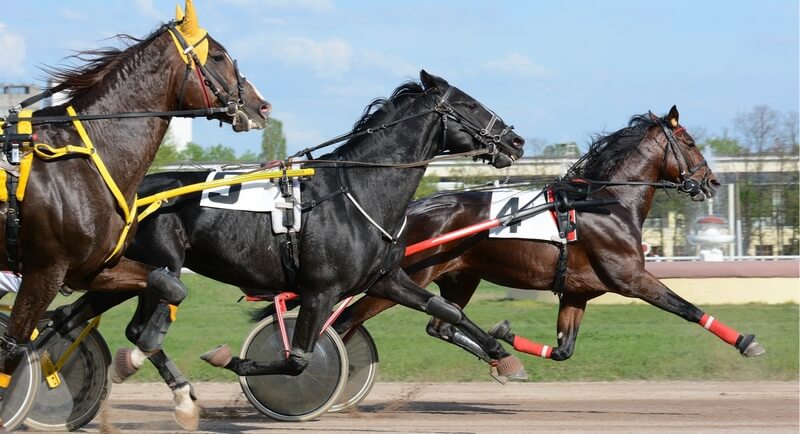
Trotting is a form of harness racing. Each horse pulls a light two-wheeled cart called a sulky, with the driver seated behind it, and has to keep a set gait for the whole race. A trotter moves its legs in diagonal pairs: left front with right hind, right front with left hind. A horse that switches to a gallop during the race has broken its gait.
Trot and pace: two gaits in harness racing
Harness racing has a second gait, the pace. A pacer moves both legs on the same side together, and most pacers race in hopples, straps that link the front and hind leg on each side. In continental Europe harness races are for trotters only. In Australia, Canada, New Zealand, the United Kingdom and the United States pacers race too, and in North America they account for 80 to 90 per cent of all harness races.
In North America only Standardbred horses race in harness. The breed takes its name from the early registry standard: to be entered, a horse had to trot a mile in two minutes thirty seconds or better.
Racetracks in the trotting line
Every group in the section is one racetrack, labelled by country and track name, such as "USA. Northfield Park Harness" or "Canada. Woodbine Mohawk Harness". Race cards change from day to day; tracks that appear in the line include, for example:
Group in the line | Location | Track facts |
|---|---|---|
Mariendorf, Berlin, Germany | trotting track founded in 1913; since 1952 it has hosted the German Trotting Derby (Deutsches Traber-Derby) every year; today the final is run in August over 1,900 metres for four-year-olds | |
Campbellville, Ontario, Canada | opened in 1963 as Mohawk Racetrack, renamed in 2018; seven-eighths of a mile; home of the North America Cup for three-year-old pacers and the Maple Leaf Trot | |
Northfield, Ohio, USA | half-mile track near Cleveland, opened in 1957; racing all year round since 1985 | |
Örebro, Sweden | track opened in 1954; since 2003 it has hosted the Örebro Intn'l, run over 3,140 metres |
The Trotting Triple Crown is a series for three-year-old trotters made up of the Hambletonian, the Yonkers Trot and the Kentucky Futurity. The Futurity is the oldest of the three: it has been run since 1893 at the Red Mile in Lexington, Kentucky, a one-mile track of red clay founded in 1875. From 2027 the Hambletonian moves to Hoosier Park in Anderson, Indiana.
What to check before a harness race
Post position. The closer a horse starts to the inside rail, the better its chance, especially on smaller tracks. A horse that finds no spot on the rail races "parked out" and loses ground on every turn.
Breaks. In North American race programs a break is marked with an X. The driver of a horse that breaks has to slow it down and take it to the outside until it returns to its gait.
Type of start. Most races start behind a mobile gate fitted to a moving vehicle; at the start line its wings fold up and the car pulls away. Many European races use a standing start instead.
Trotting in the pre-match line
Trotting sits in the pre-match sports betting line of 1xBet, with races listed before the start under the name of their track. To get one, open a 1xBet account.